
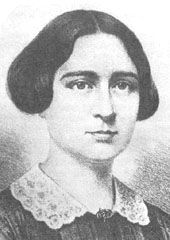
In honor of Women's Week in the United Church of Christ this coming week I wanted to write about one of the firsts in the UCC: the first ordained woman in America of a recognized major Christian denomination. Her name is Antoinette Brown.
Born May 20, 1825 on a farm in frontier New York, Antoinette Brown was the seventh of ten children. She was active from the age of nine in her local Congregational church, and decided to become a minister. After teaching for a few years, she enrolled in one of the few colleges open to women, Oberlin College, taking the women's curriculum and then the theological course. However, she was not permitted to graduate from that course, because of their gender.
At Oberlin College, a fellow student, Lucy Stone (later a leader in the Women's Suffrage Movement), became a close friend, and they maintained this friendship throughout life. After college, not seeing options in ministry, Antoinette Brown began lecturing on women's rights, slavery, and temperance. Then she found a position in 1853 at the South Butler Congregational Church in Wayne County, New York. She was paid the small annual salary (even for that time) of $300.
It was not long, however, before Antoinette Brown realized that her religious views (regarding original sin and predestination) and ideas about women's equality were more liberal than those of the Congregationalists. An experience in 1853 also may have added to her unhappiness: she attended the World's Temperance Convention but, though a delegate, was refused the right to speak. She asked to be let go from her ministerial position in 1854.
After some months in New York City working as a reformer while writing of her experiences for the New York Tribune, she married Samuel Blackwell on January 24, 1856. She met him at the 1853 temperance convention, and discovered that he shared many of her beliefs and values, including supporting women's equality. Antoinette's friend Lucy Stone had married Samuel's brother Henry in 1855. Elizabeth Blackwell and Emily Blackwell, pioneer women physicians, were sisters of these two brothers.
While raising five daughters, Brown read widely, and took special interest in natural topics and philosophy. She remained active in women's rights and the abolitionist movement.
Her speaking talents were well known, and put to good use in the cause of woman suffrage. She aligned herself with her sister-in-law Lucy Stone's wing of the woman suffrage movement.
In 1878 she switched her allegiance to the Unitarians, taking a preaching position with a small church in Elizabeth, New Jersey in 1908, which she held until her death in 1921. Antoinette Brown lived long enough to vote in the presidential election of November, woman suffrage having taken effect earlier that year.

No comments:
Post a Comment